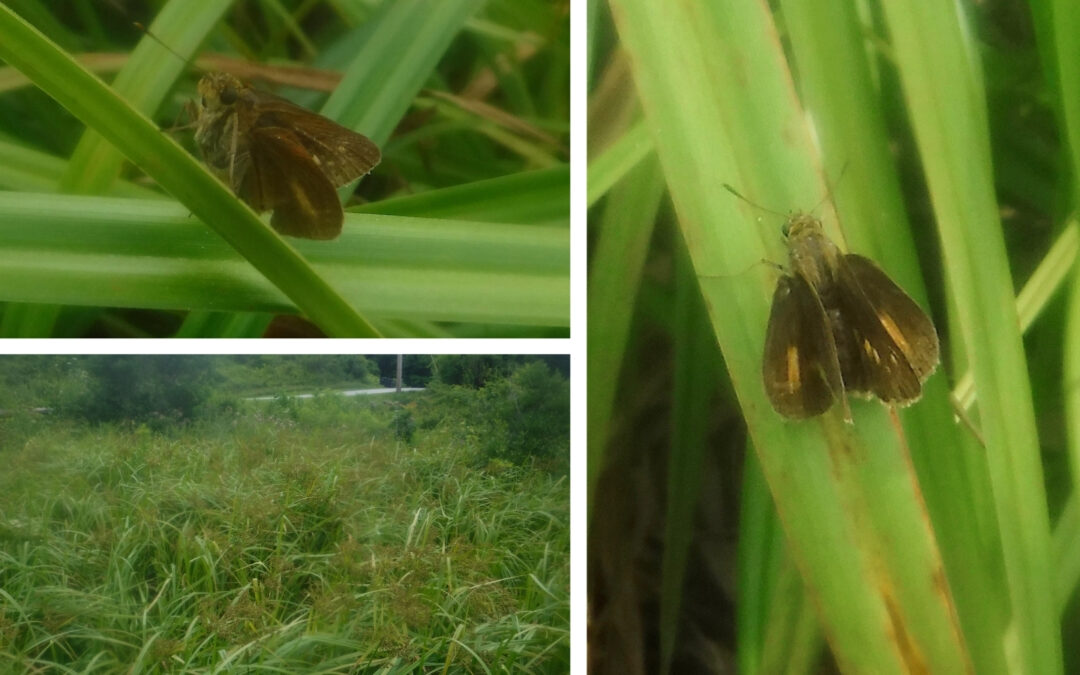
by Bedford Audubon Summer Field Biologist Jennifer Sepanara
Measuring about an inch in length, the dion skipper (Euphyes dion) is a little butterfly, but for us at Bedford Audubon, it’s a big deal. We recently confirmed the presence of this species at our Hunt-Parker Sanctuary, where we’ve found it in the past, and were glad to see it return another year.
Inhabiting wetlands where the larvae feed on sedges, the species exists in scattered populations across the eastern United States. But just how rare is it? On a global scale, the population is listed as “secure” meaning that it’s at low risk of extinction on a planetary basis; nor is it listed as endangered or threatened federally. But when you zoom in to a finer gradient, the picture changes. Within the state of New York, conservationists have assigned it a rank of “vulnerable,” or 3 on a scale of 5, meaning that it’s at moderate risk of extirpation (or local extinction) within the state, likely because of its patchy distribution, relatively low numbers, specific habitat requirements, or other factors.
Just how many dion skippers are there in the state? While it’s hard to know for sure, the species has been documented about 100 times in New York on iNaturalist, an online community science platform where users upload photographs and other media of species observations. In comparison, there are over 18,000 New York observations of the more familiar monarch butterfly. While the number of iNaturalist observations doesn’t necessarily correlate with true abundance, with conspicuous or highly charismatic species photographed more frequently, it does give you a sense of the dion skipper’s sparseness.
A popular field guide published in 1999 lists the flight period (the time of year when adults are active) of dion skippers in New York as the first half of July. Interestingly, the iNaturalist observations of this species in Westchester County range from June 21 to July 13. Populations of every species are likely to have a few outliers; think of this as an evolutionary “insurance policy.” If environmental conditions change and survival in July becomes untenable, a few individuals will have survived to carry the population onward. So the earlier records could simply be a result of natural variation within the population, or they could be due to Westchester County’s location in the southern (and likely warmer) part of the state. It is also possible that the species is experiencing a true shift in phenology, or biological timing, as a result of a changing climate or other factors. Everyday citizens can help us answer questions like this by keeping your eyes (and ears) out for local flora and fauna, and documenting your findings on community science outlets such as iNaturalist, eBird or eButterfly.
It’s also important to support the work of local and regional conservation organizations, who strive to protect habitat for vulnerable species. After all, global extinctions start with local extinctions, like the lights of a city going out one by one at night until it’s completely dark.
Help us keep a light on for the dion skipper.
Range Map
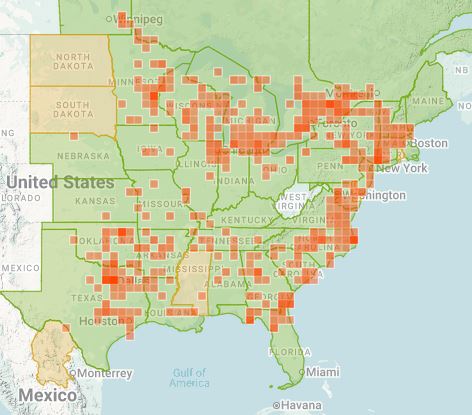
Click the map to read more about the dion skipper on iNaturalist